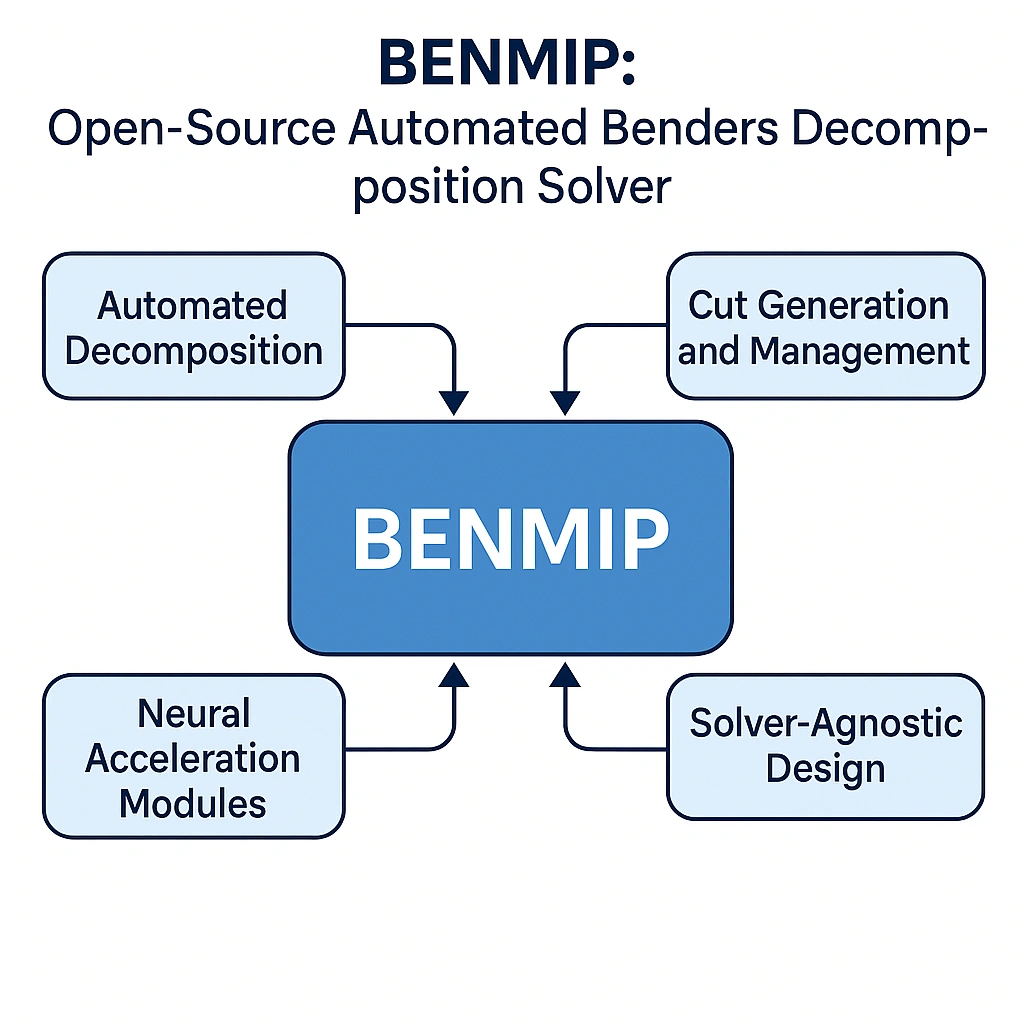
BENMIP: Open-Source Automated Benders Decomposition Solver
Project Description
Overview
The BENMIP project developed an open-source framework for Automated Benders Decomposition, designed to accelerate the solution of large-scale mixed-integer and nonlinear optimization problems.
The initiative responded to the growing need for transparent, adaptive, and efficient decomposition frameworks that unify rigorous mathematical programming with data-driven intelligence.
Although the main development phase has been completed, the BENMIP solver continues to be actively maintained and updated, with ongoing improvements and community contributions ensuring its long-term evolution.
Research Objectives
The project aimed to create an intelligent and fully automated decomposition environment capable of solving complex optimization problems with minimal manual intervention.
Its key objectives were to:
-
Automate problem structure detection and master–subproblem decomposition.
-
Implement adaptive cut management and learning-based acceleration strategies.
-
Enable cross-domain applicability across logistics, energy, and infrastructure design.
-
Promote open science, reproducibility, and collaborative development within the optimization community.
Technical Approach
The BENMIP framework combined theoretical and computational advances through:
-
Automated Decomposition Detection – Algorithms for identifying separable structures and linking constraints in large-scale formulations.
-
Cut Generation and Management – Adaptive selection of primal, dual, and combinatorial cuts based on real-time convergence behavior.
-
Neural Acceleration Modules – Machine learning components predicting effective cut sequences and stabilization settings.
-
Solver-Agnostic Design – Compatibility with Gurobi, CPLEX, and open-source solvers.
-
Parallel Execution – Distributed subproblem handling for scalability and performance.
Methodology Framework
-
Model Analysis – Automatic recognition of decomposable problem structures.
-
Master–Subproblem Coordination – Dynamic exchange mechanisms between decision and constraint layers.
-
Adaptive Learning Layer – Integration of data-driven models to improve cut efficiency.
-
Validation and Benchmarking – Extensive testing on academic and industrial datasets.
Open Science and Maintenance
BENMIP was released as an open-source solver under a permissive license to encourage transparency and reuse.
The codebase remains actively maintained, with periodic updates that extend functionality, improve computational efficiency, and integrate new research modules contributed by the optimization community.
It continues to serve both as a research platform for hybrid algorithm design and as a teaching tool for decomposition-based optimization.
Expected Outcomes and Impact
-
A stable, extensible open-source solver for automated Benders decomposition.
-
Reduced modeling and configuration time for practitioners and researchers.
-
Reusable benchmarks and reproducible workflows for large-scale optimization studies.
-
A living framework that bridges classical operations research and modern AI-driven solver design.