Cloud-Based River Water Level Monitoring System
Project Description
Overview
This project developed a cloud-enabled water level monitoring and early-warning system designed to improve flood prediction and environmental safety.
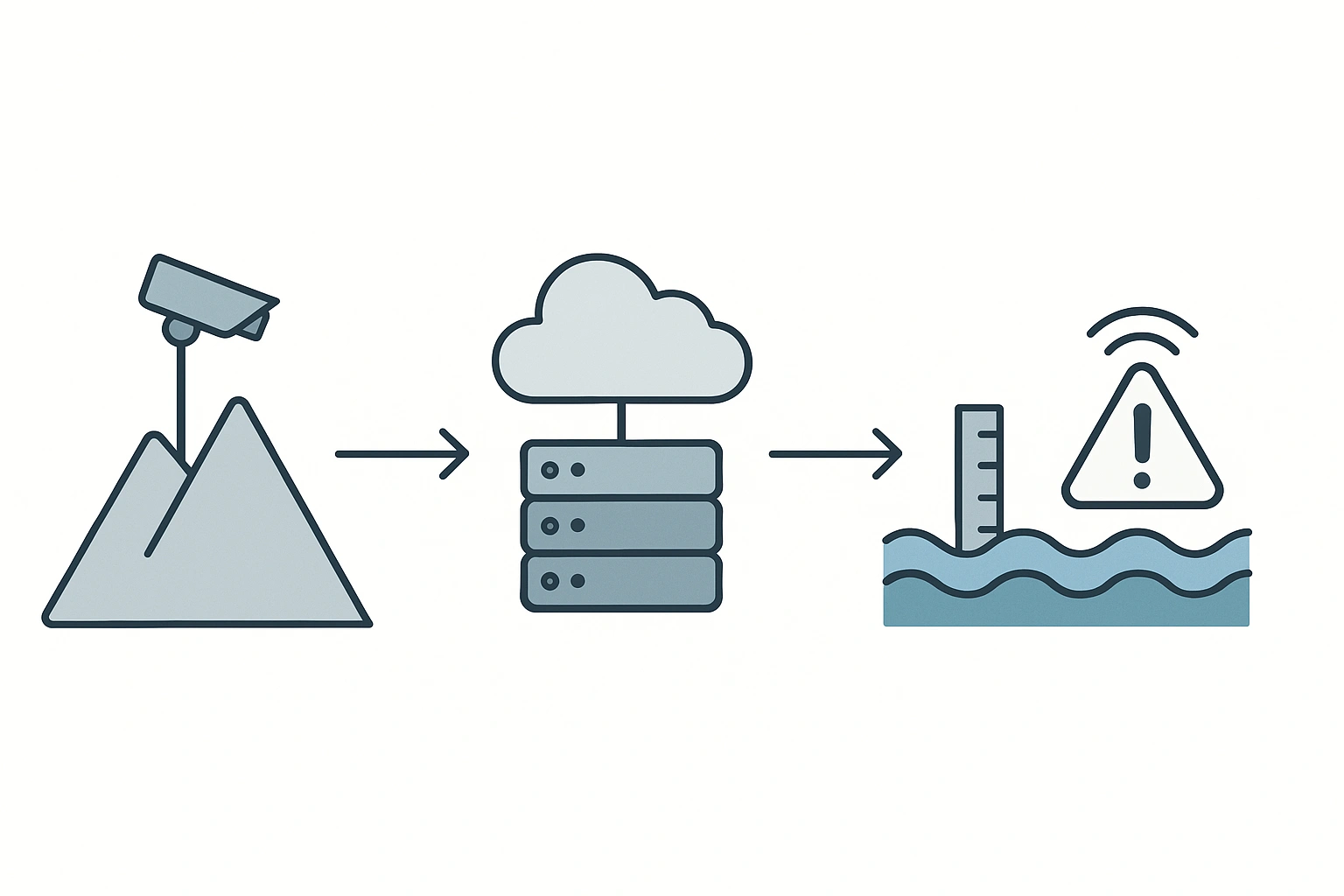
By using high-resolution cameras installed at elevated points, including mountain regions and riverbanks, the system performs long-term visual surveillance of river water levels.
The data is continuously processed and stored on cloud servers, enabling real-time monitoring and historical analysis to support proactive flood prevention and infrastructure resilience.
Research Objectives
The primary goal of the project was to design a scalable, low-maintenance, and automated system capable of observing and predicting water level variations under diverse environmental conditions.
Key objectives included:
-
Implementing remote visual monitoring through long-range cameras in isolated or elevated terrains.
-
Integrating cloud-based analytics for real-time data storage, processing, and visualization.
-
Developing automated detection algorithms to identify critical water level thresholds and send alerts.
-
Supporting long-term environmental data collection for hydrological research and regional safety planning.
Technical Approach
The system integrates advanced sensing, computer vision, and cloud computing technologies:
-
Edge Video Capture – Cameras configured with solar-powered modules for 24/7 operation in remote areas.
-
Cloud Processing – Data transmitted via secure IoT channels to cloud servers for automated analysis.
-
AI-Based Water Level Estimation – Algorithms detect river boundaries and estimate level variations through time-series visual analytics.
-
Alert Mechanism – Automated notifications triggered when significant deviations or flood risks are detected.
Methodology Framework
-
Site Selection – Installation of cameras at high vantage points ensuring wide coverage and visibility of river flows.
-
Data Acquisition – Continuous capture of time-lapse imagery and environmental parameters.
-
Cloud Integration – Transmission to scalable cloud infrastructure for analysis and long-term storage.
-
Flood Risk Modeling – Use of predictive algorithms to forecast rapid water level rises and potential overflow.
-
Public and Institutional Access – Authorized dashboards for local authorities and disaster management units.
Expected Outcomes
-
Improved early flood detection through continuous river monitoring.
-
Cloud-based data architecture enabling real-time access and predictive insights.
-
Reduced environmental risk and better protection of downstream communities.
-
Open framework adaptable to other geographic regions and environmental monitoring projects.
Research Areas Alignment
This project aligns with ongoing work in:
-
Environmental Informatics – Application of AI and IoT to ecological monitoring and sustainability.
-
Computer Vision for Infrastructure Safety – Real-time analysis of natural phenomena via video surveillance.
-
Cloud and Edge Computing – Distributed architectures for data-intensive monitoring systems.
-
Disaster Risk Management – Digital tools for anticipatory flood response and community protection.