Optimisation models are written in variables and constraints. The disruptions that make a schedule wrong arrive as sentences: "hydraulic leak on press 3, maintenance says about 40 minutes." Between the two sits a planner who reads the note, works out which machine is meant, estimates the outage, edits the model and reruns it. GenOR-Twin, a paper by Rahimeh Neamatian Monemi, Shahin Gelareh, Lubin Cui and Nelson Maculan, asks how much of that step can be automated without giving up the guarantees that make exact optimisation worth using.
Translate, Do Not Solve
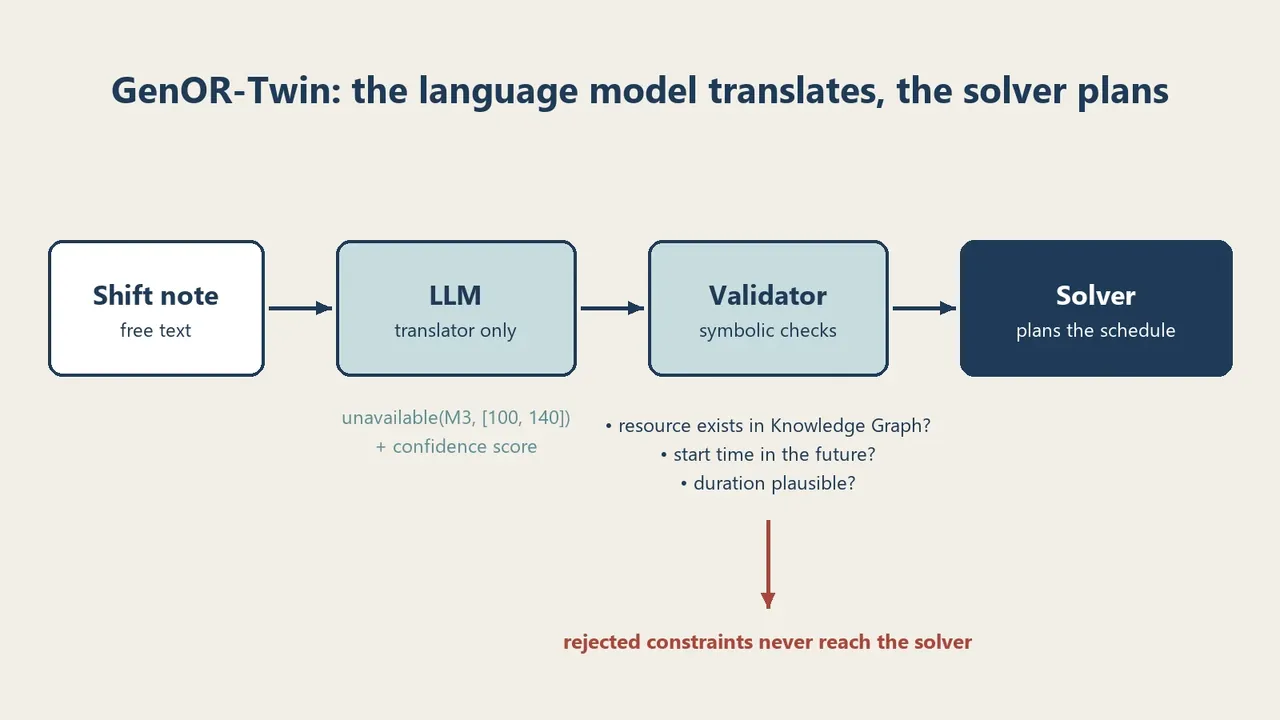
The paper's central choice is to keep the language model away from planning. Scheduling problems such as job shop scheduling, vehicle routing and resource-constrained project scheduling are NP-hard, and a solver's output respects every constraint in its model. A language model offers no such guarantee: it can produce a plan that reads well and double-books a machine. In GenOR-Twin the model acts only as a translator. It reads the note and proposes a constraint, such as unavailable(M3, [100, 140]), with a confidence score. The existing solver does all of the planning.
A Validator Between the Two
A proposed constraint passes through a symbolic validator before it reaches the solver. The validator asks three questions. Does the resource exist in the site's Knowledge Graph? Is the start time in the future? Is the duration physically plausible? A constraint that fails any check is rejected. The point is to give the interpretation a place where it can be checked, instead of letting a misread note flow straight into the plan.
The paper evaluates this on 300 historical operational logs, 50 in each of six problem domains, annotated independently by two experts with Cohen's κ = 0.91. With the validator, the pipeline matched the expert reading in 299 cases (99.7%), against 97.2% for the same model without it. On highly ambiguous logs, where the raw match rate falls to 76.5%, the validator caught 88.2% of the hallucinated extractions.
Deciding How Hard to React
Once a constraint is accepted, the system still has to decide whether a small repair is enough. GenOR-Twin's SmartScheduler compares the length of the disruption with the schedule's average slack and checks whether the affected machine is a bottleneck. A short outage on a non-bottleneck machine gets a local right-shift repair; a long outage, or one on a bottleneck, triggers full re-optimisation. When the model's confidence is at or below 0.85, the case goes to a person, who checks one interpretation instead of rebuilding the schedule. In a controlled study, planners using this policy chose the right response 98.0% of the time, against 79.5% for planners working alone.
What the Results Show
On Taillard job shop, Solomon routing and PSPLIB project scheduling instances, the pipeline gave objectives 3.7% to 4.9% better than a rule-based extraction pipeline, over 100 runs per benchmark (p < 0.01). The gains are modest, and the paper says so; the rule-based baseline's main weakness was that it could not parse 82% of the varied phrasing found in real logs. Semantic inference took about 2 milliseconds whether the schedule had 25 operations or 50,000, so the language model is not the bottleneck.
Why It Matters for the Consortium
GenOR-Twin brings together two threads of NEDMIL's work: exact mathematical optimisation and the use of learning methods where they help without weakening guarantees. The same pattern, with learned components proposing and symbolic or exact components checking and deciding, appears in other consortium projects, from ML-guided cuts in the BENMIP decomposition framework to decision support for maintenance planning. The full paper is available on arXiv.