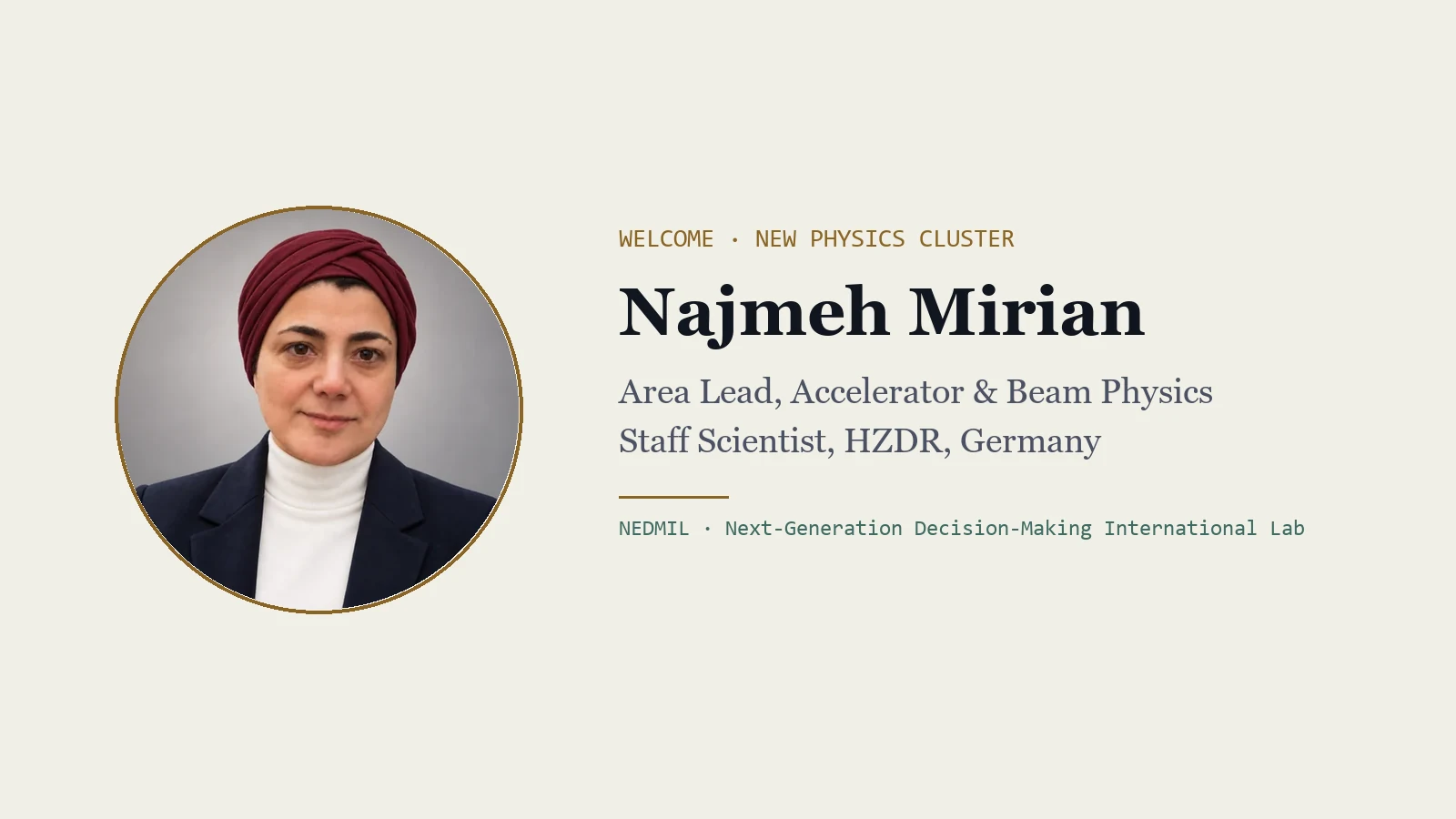
We are delighted to welcome Dr. Najmeh Mirian to NEDMIL as Area Lead. Najmeh is a Staff Scientist at Helmholtz-Zentrum Dresden-Rossendorf (HZDR) in Germany, and an accelerator physicist with more than twelve years of international experience in beam dynamics, machine operation, accelerator design, and numerical simulation.
A Career at Leading Accelerator Laboratories
Before joining HZDR in 2024, Najmeh worked as a scientist at DESY in Hamburg on FLASH and the European XFEL, and at FERMI, the free-electron laser facility of Elettra Sincrotrone Trieste. She has also collaborated with CERN on feasibility studies for the Future Circular Collider (FCC-ee) and on the LHeC energy-recovery linac. At HZDR she works on THz accelerator development, lattice design for the DALI accelerator, and AI-assisted accelerator control at ELBE.
Her research focuses on electron beam dynamics, free-electron lasers, microbunching instability, and THz radiation sources. She combines theoretical analysis with numerical modelling and simulation, and has developed tools used in day-to-day machine operation — among them JINA, a semi-analytical code for microbunching-instability calculations, and several diagnostic and optimisation applications for FLASH and the European XFEL. Her work has appeared in Nature Photonics, Physical Review Letters, and Physical Review Accelerators and Beams.
A New Physics Cluster
Najmeh's arrival marks a new step for the consortium: NEDMIL is opening a new research cluster in physics, with accelerator and beam physics as its first area and Najmeh as its lead.
The connection to our existing work is closer than it may first appear. Operating and designing a particle accelerator is a demanding decision problem: hundreds of interacting parameters, expensive and noisy measurements, strict safety constraints, and physical models that must be trusted under uncertainty. These are exactly the conditions in which optimisation, machine learning, and simulation-based decision support prove their value — and in which they are tested hardest. In return, physics brings the consortium rigorous models and demanding real-world systems on which to develop and validate new methods.
The cluster will initially focus on electron beam dynamics and collective effects, free-electron lasers and THz radiation sources, simulation-based accelerator design and diagnostics, and AI-assisted accelerator control and machine optimisation.
Looking Ahead
We invite researchers working at the interface of physics, optimisation, and artificial intelligence to get in touch and explore collaboration with the new cluster.
Welcome to NEDMIL, Najmeh — we look forward to building this new direction together.